 |
|
World |
India |
Karnataka 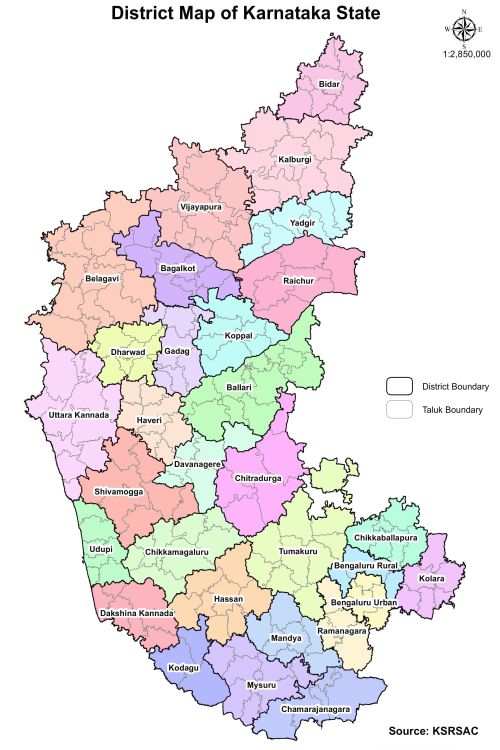 The state is bordered by the Lakshadweep Sea to the west, Goa to the northwest, Maharashtra to the north, Telangana to the northeast, Andhra Pradesh to the east, Tamil Nadu to the southeast, and Kerala to the southwest. Karnataka is the only southern state to have land borders with all of the other four southern Indian sister states. Capital: Bengaluru (formerly Bangalore), known as the "Silicon Valley of Asia" due to its thriving IT industry. Formation: Formed on November 1, 1956, originally as Mysore State, and renamed Karnataka in 1973. Geography: Karnataka is India's sixth-largest state by area and has a diverse geography including a coastal plain, the Western Ghats, and the Karnataka Plateau. The state has three principal geographical zones: 1. The coastal region of Karavali and Tulu Nadu 2. The hilly Malenadu region comprising the Western Ghats 3. The Bayaluseeme region comprising the plains of the Deccan Plateau The two main river systems of the state are the Krishna and its tributaries, the Bhima, Ghataprabha, Vedavathi, Malaprabha and Tungabhadra in North Karnataka, and the Kaveri and its tributaries, the Hemavati, Shimsha, Arkavati, Lakshmana Thirtha and Kabini, in South Karnataka. Other prominent rivers such as the Sharavati in Shimoga and Netravati in Dakshina Kannada flow westward to the Lakshadweep Sea. Language: Kannada is the official language and most widely spoken language. Other languages include Urdu, Konkani, Marathi, Tulu, Tamil, Telugu, Malayalam, Kodava, and Beary. Economy: Karnataka is one of the highest economic growth states in India, with its economy driven by sectors like information technology, biotechnology, manufacturing, and agriculture. Karnataka has a bicameral legislature with Legislative Assembly and Legislative Council. The Legislative Assembly consists of 224 members. The Legislative Council is a permanent body of 75 members. For administrative purposes, Karnataka has been divided into four revenue divisions, 49 sub-divisions, 31 districts, 175 taluks and 745 hoblies / revenue circles. Karnataka has 25 wildlife sanctuaries and five national parks. Popular among them are Bandipura National Park, Bannerghatta National Park and Nagarhole National Park. The ruins of the Vijayanagara Empire at Hampi and the monuments of Pattadakal are on the list of UNESCO's World Heritage Sites. The Hoysala temples at Beluru and Halebidu, which were built with Chloritic schist (soapstone) are proposed UNESCO World Heritage sites. The Gol Gumbaz and Ibrahim Rauza are famous examples of the Deccan Sultanate style of architecture. The monolith of Gomateshwara Bahubali at Shravanabelagola is the tallest sculpted monolith in the world, attracting tens of thousands of pilgrims during the Mahamastakabhisheka festival. Jog Falls is India's tallest single-tiered waterfall with Gokak Falls, Unchalli Falls, Magod Falls, Abbey Falls and Shivanasamudra Falls among other popular waterfalls. Several popular beaches dot the coastline, including Murudeshwara, Gokarna, Malpe and Karwar. Several Hindu temples including the famous Udupi Sri Krishna Matha, the Marikamba Temple at Sirsi, the Kollur Mookambika Temple, the Sri Manjunatha Temple at Dharmasthala, Kukke Subramanya Temple, Janardhana and Mahakali Temple at Ambalpadi, Sharadamba Temple at Shringeri attract pilgrims from all over India. Shravanabelagola, Mudabidri and Karkala are famous for Jain history and monuments. The Shettihalli Rosary Church near Shettihalli, an example of French colonial Gothic architecture, is a rare example of a Christian ruin, is a popular tourist site. Mysore Dasara is celebrated as the Nada habba (state festival) and this is marked by major festivities at Mysore. Bengaluru Karaga, celebrated in the heart of Bengaluru, is the second most important festival celebrated in Karnataka. Ugadi (Kannada New Year), Makara Sankranti (the harvest festival), Ganesh Chaturthi, Gowri Habba, Ram Navami, Nagapanchami, Basava Jayanthi, Deepavali, and Balipadyami are the other major festivals of Karnataka. |