 |
|
World |
India |
Uttar Pradesh 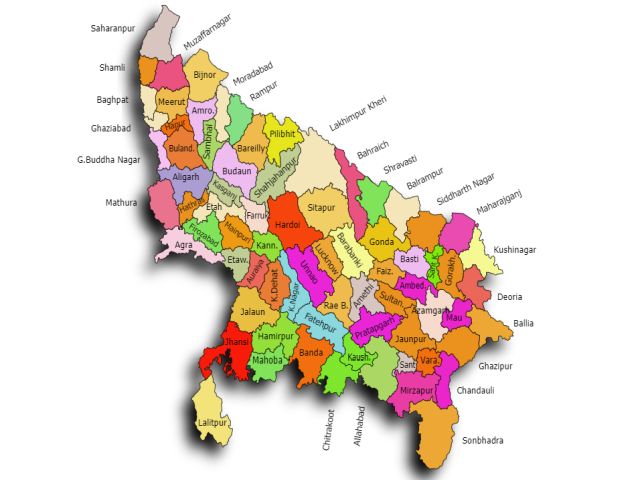 Uttar Pradesh was established in 1950 after India had become a republic. It is a successor to the United Provinces, established in 1935 by renaming the United Provinces of Agra and Oudh, in turn established in 1902 from the North-Western Provinces and the Oudh Province. On 9 November 2000, a new state, Uttaranchal (now Uttarakhand), was created from Uttar Pradesh's western Himalayan hill region. The two major rivers of the state, the Ganges and its tributary Yamuna, meet at the Triveni Sangam in Prayagraj, a Hindu pilgrimage site. Other notable rivers are Gomti and Sarayu. Inhabitants of the state are called Awadhi, Bagheli, Bhojpuri, Brajwasi, Bundeli, or Kannauji, depending upon their region of origin. Hinduism is practised by more than three-fourths of the population, followed by Islam. Hindi is the most widely spoken language and is also the official language of the state, along with Urdu. The major Hindi languages of the state are Awadhi, Bagheli, Bundeli, Braj Bhasha, Kannauji, and Hindustani. Bhojpuri, an Eastern Indo Aryan language, is also spoken in the state. Uttar Pradesh boasts three UNESCO World Heritage Sites: the Taj Mahal, Fatehpur Sikri, and Agra Fort, all located in Agra. The ancient city of Varanasi is renowned for its spiritual significance, with rituals along the Ganges River. Uttar Pradesh is one of the seven states in India, where the state legislature is bicameral, comprising two houses: the Vidhan Sabha (Legislative Assembly) and the Vidhan Parishad (Legislative Council). The Legislative Assembly consists of 404 members and the Legislative Council is a permanent body of 100 members. The state contributes 80 seats to Lok Sabha and 31 seats to Rajya Sabha. Uttar Pradesh is divided into 75 districts under these 18 divisions. Religious tourism plays a significant role in the state's economy. Varanasi is a major religious hub and one of the seven sacred cities (Sapta Puri) in Hinduism and Jainism. Vrindavan is considered to be a holy place for Vaishnavism. Sravasti generally considered as revered sites in Buddhism, believed to be where the Buddha taught many of his Suttas (sermons). Owing to the belief as to the birthplace of Rama, Ayodhya (Awadh) has been regarded as one of the seven most important pilgrimage sites. Millions gather at Prayagraj to take part in the Magh Mela festival on the banks of the Ganges. This festival is organised on a larger scale every 12th year and is called the Kumbh Mela, where over 10 million Hindu pilgrims congregate in one of the largest gatherings of people in the world. Buddhist attractions in Uttar Pradesh include stupas and monasteries. The historically important towns of Sarnath where Gautama Buddha gave his first sermon after his enlightenment and died at Kushinagar; both of which are important pilgrimage sites for Buddhists. Also at Sarnath are the Pillars of Ashoka and the Lion Capital of Ashoka, both important archaeological artefacts with national significance. At a distance of 80 km (50 miles) from Varanasi, Ghazipur is famous not only for its Ghats on the Ganges but also for the tomb of Lord Cornwallis, the 18th-century Governor of East India Company ruled Bengal Presidency. The tomb is maintained by the Archaeological Survey of India. Jhansi Fort, located in the city of Jhansi, is closely associated with the "First War of Indian Independence", also known as the "Great Rebellion" or the Indian Rebellion of 1857. Renowned Indian writers who have resided in Uttar Pradesh were Kabir, Ravidas, and Tulsidas, who wrote much of his Ram Charit Manas in Varanasi. The festival of Guru Purnima is dedicated to Sage Vyasa, and also known as Vyasa Purnima as it is the day which is believed to be his birthday and also the day he divided the Vedas. The popular folk music of Uttar Pradesh includes sohar, which is sung to celebrate the birth of a child. Evolved into the form of semi-classical singing, Kajari sung during the rainy season, and its singing style is closely associated the Benares gharana. Ghazal, Thumri and Qawwali which is a form of Sufi poetry is popular in the Awadh region, Rasiya (especially popular in Braj), which celebrate the divine love of Radha and Krishna. Khayal is a form of semi-classical singing which comes from the courts of Awadh. Other forms of music are Biraha, Chaiti, Chowtal, Alha, and Sawani. Kathak, a classical dance form, owes its origin to the state of Uttar Pradesh. Ramlila is one of the oldest dramatic folk dances; it depicts the life of the Hindu deity Rama and is performed during festivals such as Vijayadashami. Nautanki is a traditional form of folk theatre that originated in Uttar Pradesh. It typically portrays a variety of themes ranging from historical and mythological tales to social and political commentary. In the gharana dance form, both the Lucknow and the Benares gharanas are situated in the state. Charkula is popular dance of the Braj region. Chhath Puja is the biggest festival of eastern Uttar Pradesh. The Kumbh Mela, organised in the month of Maagha (February - March), is a major festival held every twelve years in rotation at Prayagraj on the river Ganges. Lathmar Holi is a local celebration of the Hindu festival of Holi. It takes place well before the actual Holi in the town of Barsana near Mathura. Taj Mahotsav, held annually at Agra, is a colourful display of the culture of the Braj area. Ganga Mahotsav, a festival of Kartik Purnima, is celebrated fifteen days after Diwali. |